

Massage for Tennis Players: Boost Your Game with Elite Healers Sports Massage
Tennis is a full kinetic chain sport. Every serve, groundstroke, and split-step transfers force from your feet through your hips, core, and shoulder, and that load accumulates. The serve, the split-step, and the backhand each place specific, measurable demand on your rotator cuff, forearm extensors, hip flexors, and lumbar spine. At Elite Healers, our tennis-specific massage protocol targets the exact muscle groups and connective tissue under highest demand: rotator cuff, forearm flexors and extensors, hip flexors, and lumbar stabilizers. We treat the pattern, not just the pain site.
Our specialized treatments are tailored to the specific muscle demands of tennis, enhancing mobility, reducing muscle tension, and supporting faster recovery.
Whether you are a USTA league player, a Central Park court regular, an East Side or Upper East Side club member, or a serious recreational player chasing better performance and fewer injuries, our tennis-specific protocol is built around the structural demands of your game.
Sessions are available in 60-minute, 90-minute, and 2-hour formats at our Midtown Manhattan office at 120 East 56th Street, Suite 420. Same-week availability across our team. FSA and HSA accepted for medical massage with a doctor's referral.
Protect your serve and stop working around tennis elbow. Sport-specific massage built for the tennis kinetic chain.
Licensed therapists · Midtown East · Open 7 days · Sessions from $169 · FSA/HSA eligible for medical massage with a doctor's referral
Treating Tennis Elbow: Lateral Epicondylitis Massage in NYC
The most common overuse injury in tennis, lateral epicondylitis develops when repetitive wrist extension, particularly through backhand mechanics or off-center contact, overloads the extensor tendon insertion at the lateral epicondyle.
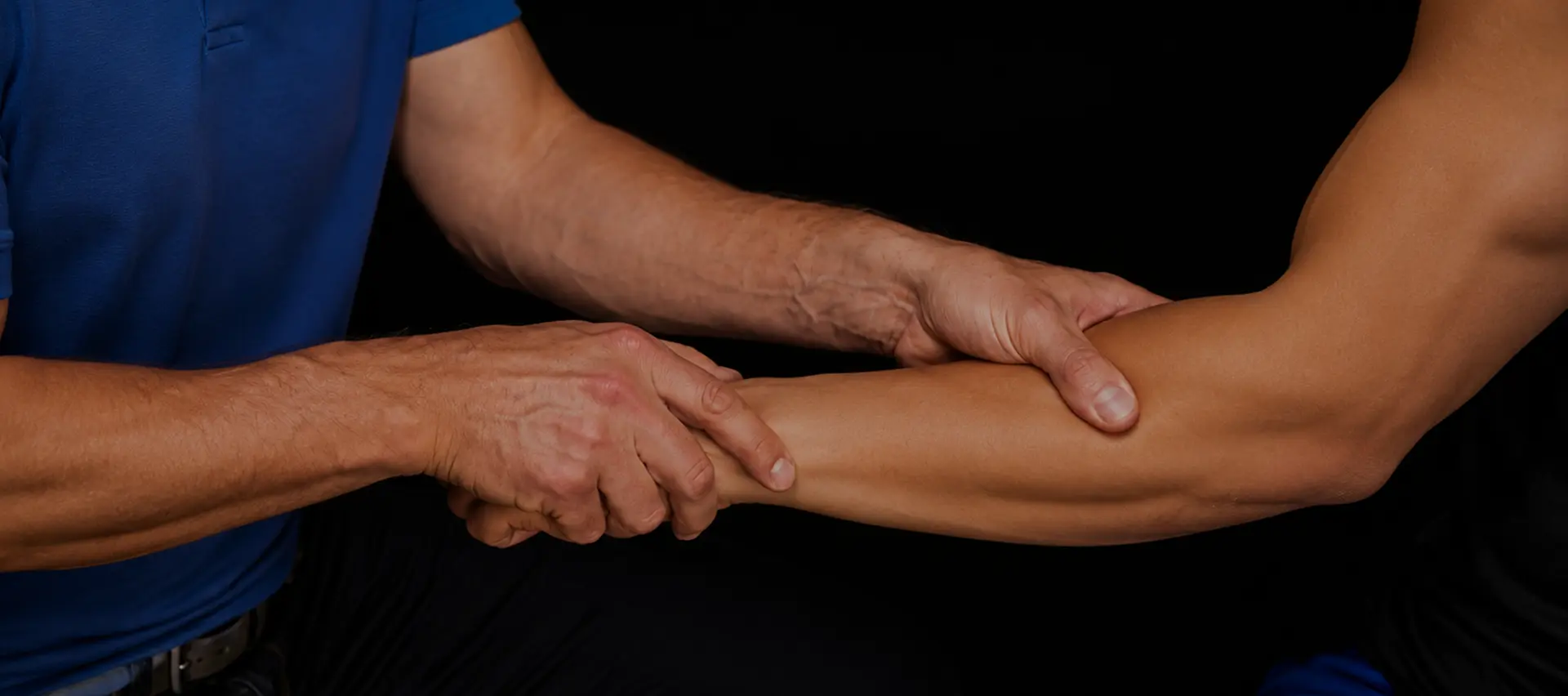
Our protocol addresses the full forearm extensor chain using deep transverse friction, myofascial release, and graduated pressure techniques. We work proximally and distally from the pain site, because lateral epicondylitis is rarely isolated to the point of pain. Most clients report significant grip strength improvement and reduction in forearm tightness within 2 to 3 sessions. For a persistent case, we coordinate with your physician or physical therapist as part of your medical massage plan.

Timing Your Sports Massage to Your Training Cycle
Our therapists specialize in beginners through advanced players.
Integrating sports massage into your training cycle is essential for building strength, enhancing flexibility, and preventing injuries. The right timing can significantly influence your recovery, performance, and injury prevention.
- For beginners: As a beginner, your training focuses on developing coordination, strength, and endurance while minimizing injury risk. Regular sports massages during this phase help ease muscle soreness, improve flexibility, and support skill development. We recommend scheduling massages after intense practice sessions or during recovery weeks to keep your body pain-free and primed for progress.
- For intermediate players: At the intermediate level, it is all about refining skills and pushing your limits. Our customized sports massages support your body's adaptation to increased intensity by reducing muscle tension and preventing overuse injuries. We suggest scheduling massages during high-volume training weeks or after competition preparation sessions to maintain peak mobility.
- For advanced players: For elite and competitive players, massage therapy is a vital part of maintaining peak performance and recovering from high-intensity practices or tournaments. Weekly massages are recommended during in-season play to reduce muscle fatigue, alleviate soreness, and optimize muscle function.
- When to get a sports massage: Sessions should be scheduled during recovery phases, after intense practice days, or at the end of strength training blocks to alleviate muscle fatigue, improve circulation, and maintain flexibility.

Is Our Tennis Massage Right For You?
Our sports massage program for tennis players is built for athletes who treat their game like an investment, not a hobby. You will get the most out of working with us if you are:
- A USTA league player competing through the season who needs consistent recovery support to stay match-ready.
- A Central Park court regular or East Side club member dealing with recurring shoulder, elbow, or wrist tension.
- A competitive tournament player building toward sectionals, regionals, or open-level competition.
- A recreational player dealing with tennis elbow (lateral epicondylitis) that has not resolved with rest, ice, or a brace.
- A doubles player with chronic shoulder impingement from heavy serving or overhead work.
- A player with hip or lower back tightness limiting your court coverage and serve power. See our back pain massage work.
- Recovering from a tennis-related injury and needing targeted soft tissue work to complement your physical therapy.
If your goal is pure relaxation, a Swedish or therapeutic session is the better fit. If your goal is to fix what is holding back your game and stop working around recurring issues, book a session.

Mastering the Court: The Kinetic Chain and Muscles Involved in Tennis
The explosive movements in tennis, from quick lateral sprints to powerful serves, require the coordinated effort of multiple muscle groups. The kinetic chain in tennis begins in the lower body and transfers energy all the way to the arms and hands:
- Lower body activation: The glutes and quadriceps generate stability and power for lateral movements, while the hamstrings support rapid acceleration and deceleration.
- Core strength and stability: The obliques and transversus abdominis play a key role in torso rotation, which is crucial for generating power in groundstrokes and serves.
- Upper body mechanics: The latissimus dorsi and pectoralis major transfer energy from the lower body through the arms. The deltoids and rotator cuff provide shoulder stability, while the biceps and triceps control the speed and direction of the racket.
- Forearm and wrist precision: The forearm muscles, along with the wrist flexors and extensors, contribute to the final swing execution, which is vital for shot placement and spin control.
By targeting these muscle groups with our tennis player's massage, we enhance your muscle coordination, reduce tension, and improve the overall efficiency of your movements on the court.
The Benefits of Tennis Player's Massage: Why You Need It
Boost Performance with Targeted Tennis Massage Therapy
A well-structured tennis massage therapy program offers a wide range of benefits that directly impact your performance and recovery. Here is how Elite Healers Sports Massage can help you take your game to the next level:
Shoulder and rotator cuff mobility:
The serve demands 90 degrees or more of internal rotation under load, repeatedly. When the posterior capsule tightens, serve velocity drops and impingement risk rises. We restore that range directly, targeting the infraspinatus and posterior rotator cuff before it becomes a structural problem.
Calf and Achilles complex recovery for court mobility:
The split-step is the most underappreciated load event in tennis. Executed dozens to hundreds of times per match, it places rapid eccentric demand on the gastrocnemius, soleus, and Achilles tendon, the same structures implicated in Achilles tendinopathy, calf strains, and plantar fasciitis. Recreational players in particular, who may play multiple sets in a weekend without structured recovery, accumulate this load silently until it becomes a structural problem.
Our calf and Achilles protocol combines deep tissue work through the posterior chain with trigger point release at the gastrocnemius-soleus junction, the site where tension most commonly accumulates and refers into the heel. We also address the tibialis anterior and peroneals, which compensate when the posterior chain is overloaded, to restore full lower leg balance and protect the ankle across lateral movement demands.
Knee and patellar tendon load management:
Repetitive split-stepping and lateral deceleration place sustained eccentric load on the patellar tendon and quadriceps complex. Patellar tendinopathy develops progressively, often without acute onset. By the time a player notices it, the tendon is already significantly irritated.
Our treatment addresses the full quadriceps chain: proximal quad belly, VMO, and IT band tension that alters patellar tracking. Deep tissue work releases the tissue compression driving the load asymmetry, while trigger point therapy resolves the referred pain patterns that mask where the dysfunction originates. The goal is not symptom management. It is restoring the tendon's capacity to absorb load before the next training block.
Forearm extensor recovery:
Grip fatigue is cumulative across a match. Our forearm-focused work reduces extensor tension, restores blood flow to chronically loaded tissue, and lowers the risk of lateral epicondylitis developing or recurring.
Personalizing Your Tennis Player's Massage in NYC
Every tennis player's body and playing style are unique, so we tailor every session to your specific needs. Our therapists consider your training intensity, competition schedule, and physical condition to build a personalized massage plan. The three session types below reflect how your needs change across your competitive cycle:
- Pre-match (24 to 48 hours out): Light neuromuscular activation work targeting the primary movers, the rotator cuff, hip flexors, and forearm extensors. The goal is tissue priming and range of motion, not deep structural work.
- Post-match (same day or next): Deep tissue and myofascial release targeting the kinetic chain under highest load during play. Serves: rotator cuff and posterior capsule. Groundstrokes: forearm extensors and lumbar rotators. Net play: calf and Achilles complex.
- Off-season and base phase: Structural correction work addressing the muscle imbalances that develop across a season, restoring full joint mobility, and building tissue resilience for the next training block.
More Than Just Tennis Massage
Tennis is one discipline we serve. Elite Healers provides sport-specific massage protocols across athletic disciplines alongside medical massage, deep tissue therapy, and injury rehabilitation. Every sports massage is delivered by a licensed therapist trained in the Elite Healers method, serving athletes across Midtown East and Manhattan.
Over 200 reviews at a 4.9 star average. Featured in Forbes, Muscle and Fitness, Runner's World, Newsweek, and Peloton.
Frequently Asked Questions About Tennis Massage in NYC
How Often Should Tennis Players Get a Sports Massage?
It depends on your playing volume and competitive goals. Recreational players hitting 1 to 2 times a week typically do well with a session every 3 to 4 weeks. USTA league players competing through the season benefit from a session every 2 weeks. Tournament-level competitors preparing for sectionals or higher should consider weekly sessions during peak prep. Players working through chronic tennis elbow or shoulder impingement often need 1 to 2 sessions per week for 4 to 6 weeks before transitioning to a maintenance schedule.
Can Sports Massage Help With Tennis Elbow (Lateral Epicondylitis)?
Yes. Lateral epicondylitis is one of the conditions we treat most frequently. Our protocol uses deep transverse friction, myofascial release, and graduated pressure on the forearm extensor chain to address the muscular dysfunction driving the tendon stress at the lateral elbow. Most clients report significant grip strength improvement and forearm tightness reduction within 2 to 3 sessions. For best results, combine massage with rest from the aggravating activity, technique adjustments, and any prescribed physical therapy.
Is Tennis Elbow the Same as Golfer's Elbow?
No, though they are closely related. Both are forms of epicondylitis, an overload of the tendons that attach at the elbow. Tennis elbow is lateral epicondylitis, felt on the outer elbow and driven by the wrist extensors that fire through the backhand and off-center contact. Golfer's elbow is medial epicondylitis, felt on the inner elbow and driven by the wrist flexors. Same family, opposite sides. For tennis players, our work targets the forearm extensor chain specifically.
Should I Get a Massage Before or After a Match?
Both work, but they serve different purposes. A pre-match massage is light and activating to prime the muscles and nervous system for the demand ahead, best done the morning of or the day before. A post-match massage is deeper and restorative to flush accumulated tension, reduce soreness in the rotator cuff and hip flexors, and accelerate recovery. For tournament play with multiple matches over a weekend, book your post-tournament session within 24 to 48 hours.
What Is the Difference Between Sports Massage and a Regular Spa Massage for Tennis Players?
A spa massage is built for relaxation. Sports massage is built for performance and recovery. Our tennis player's massage targets the specific muscles, fascia, and connective tissue involved in serving, groundstrokes, and court movement using deep tissue work, myofascial release, and trigger point therapy. Sessions are designed around your training cycle and specific issues like rotator cuff tension, forearm tightness, hip flexor restriction, or lower back tension, not a generic full-body routine.
Can Sports Massage Improve My Serve and Groundstroke Power?
Indirectly but measurably. Most amateur tennis players have restrictions in shoulder external rotation, thoracic mobility, hip rotation, and forearm flexibility that cap their power output and limit their ability to load and unload efficiently. Releasing those restrictions does not fix technique, but it removes the physical limitations that prevent your existing technique from producing its full potential. Most players report better range of motion in their serve within 1 to 2 sessions.
What Muscles Matter Most for Tennis Performance?
Tennis is a full kinetic chain sport. The glutes, quads, and hamstrings drive lateral movement and build the base of your power. The core and obliques rotate the torso to generate force through groundstrokes and serves. The shoulder, rotator cuff, and lats deliver the serve, and the forearm flexors and extensors control grip and racket precision. A restriction anywhere along that chain caps performance, so we assess and treat the full chain rather than one isolated area.
Do You Accept FSA or HSA for Tennis-Related Massage Treatment?
Yes, when the treatment is for a documented orthopedic condition. Tennis elbow (lateral epicondylitis), rotator cuff strain, shoulder impingement, chronic lower back pain, hip flexor strain, and other musculoskeletal conditions related to tennis often qualify. You will need a doctor's referral specifying medical massage and a Visa or Mastercard benefit card. General performance and recovery work does not qualify.
Ready to Stop Working Around Tennis Elbow and Tightness?
Whether you are a USTA league player chasing a higher rating, a tournament competitor preparing for a sectional, a club player dealing with chronic tennis elbow, or a recreational player whose game is being limited by recurring tightness, the next session is the one that moves you forward. Same-week availability across our team. FSA and HSA accepted for medical massage with a doctor's referral.
Book your tennis recovery session at 120 East 56th Street, Suite 420, Midtown Manhattan. Open 7 days. Convenient for players from East Side clubs, Central Park courts, and the broader Midtown area.
Reserve My SessionBooking takes under 60 seconds. Cancel or reschedule up to 24 hours in advance.
If you are not sure whether sports massage is the right next step for your specific tennis situation, call us at (929) 327-8126 and we will give you an honest assessment.